
Kinetics Neo
Software for kinetic analysis of thermoanalytical data for chemical processes.
Prediction of process behaviour and temperature optimization based on kinetics analysis.
Kinetics Neo software fully supports mandatory rules for kinetic analysis: "ICTAC Kinetics Committee recommendations for analysis of multi-step kinetics", doi.org/10.1016/j.tca.2020.178597 .
News
September 29, 2026 New Kinetics Neo version 4.1 ("AI") is available now. Main new feature is the AI Chat which is the new AI assistant in Kinetics Neo software. Available for free for all users with active Support Subscription.
August 3-6, 2026 We will present our latest study and new functionality of Kinetics Neo and on 52th NATAS (North American Thermal Analysis Society) Conference in Atlanta, GA, USA:
1. An Integrated AI Chat Assistant for Kinetics Analysis in NETZSCH Kinetics Neo (Elena Moukhina)
2. From Cure to Thermal Lifetime: Kinetic Insights into a Highly Filled Epoxy Underfill for Advanced Semiconductor Packaging (Ran Tao, Elena Moukhina et al)
July 1, 2026 New Kinetics Neo version 3.8.1 is available now. This version has important new features for data import directly from NETZSC Proteus Analysis (starting version 9.10), compatibility with Kinetics Lite format (released together with Proteus 9.10) and one-click automatic search of single-step kinetic model and more.
Kinetics Neo Roadmap
The actual Kinetics Neo version 4.1 was released at September 29, 2026 (see more details in Release History).
Future Releases
Q1 2027. We testing new AI features which will be included into the next version of Kinetics Neo.
What Is Kinetics Neo Software
Kinetics Neo is a software for the analysis of process rates that depend on temperature, such as chemical reactions, polymers crystallization, or ceramic sintering.
Kinetics Neo software enables the finding of kinetic models with parameters (like activation energy or reaction order), that are dependent on the chemical nature of the process, but independent of the current temperature. The model, characterized by these parameters, must accurately describe experimental data across various temperature conditions.
The model with these parameters can then be used within the Kinetics Neo software to simulate process behavior under user-defined temperature conditions and to optimize temperature settings for industrial processes.
Please have a look at the video about the basics of the Kinetics Neo and it's advanced functions and features recorded during the webinar at April 29, 2021. Important parts are:
- 02:25 Goal of kinetic analysis for chemical reactions and necessary measurements (slides 3-9, 8 minutes);
- 10:38 Analysis approaches, advantages and disadvantages (slides 10-24, 17 minutes);
- 27:54 Unique features of Kinetics Neo (slides 27-48, 23 minutes).
Kinetics Neo Can Help If You Need To:
- Determine the amount of time needed for paint to cure
- Optimize production time for qualitative ceramics
- Maximize the quality of metal powder product during polymer burnout
- Check how quickly a pharmaceutical is able to work
- Optimize a material’s synthesis process when using a new catalyst
- Find out the curing time for a dental filling.
Supported Measurement Types
Kinetics Neo Software is compatible with measurements (tests) data made by both NETZSCH and NON-NETZSCH instruments:
- Differential Scanning Calorimetry (DSC) / Differential Thermal Analysis (DTA)
- DSC with for curing reactions with diffusion control (with possible glass transition during curing process)
- Thermogravimetric Analysis (TGA) / Thermogravimetry (TG)
- Dilatometer (DIL)
- Dielectric Analysis (DEA) for curing reactions(with possible glass transition during curing process)
- Accelerating Rate Calorimetry (ARC), Multiple Module Calorimetry (MMC)
- Viscosity for curing reactions(with possible glass transition during curing process)
- Rheometry (Torque)
- Dynamic Mechanic Analysis (DMA).
Please read User's Guide on how to import source data (masurement tests) into Kinetics Neo software: https://kinetics.netzsch.com/en/learn/import-of-user-defined-data
What Makes Kinetics Neo So Valuable:
- Modern User Experience: The new interface is both intuitive and efficient, enhancing ease of use and is based on the latest technologies.
- Comprehensive Methods of Kinetic Analysis: It encompasses both model-free and model-based methods, allowing for thorough statistical comparisons across different methods.
- Advanced Numerical Model-Free Solution: This new approach delivers rapid identification of optimal model-free solution.
- Versatile Predictions: Both model-free and model-based methods are available for making predictions and optimizations.
- Visual Kinetic Modeling: Users can easy construct kinetic models for the model-based approach with any number of reaction steps and their connections.
- Flexible Adjustments: Reaction steps can be easy added, removed, or modified, and their positions can be adjusted visually.
- One-Click Optimization: Kinetic parameters for individual steps or the entire model can be optimized with a single click.
- Detailed Analysis: The software provides formal concentrations for all reactants and reaction rates for all steps as functions of time or temperature.
- Crystallization Analysis: It supports the analysis and prediction crystallization process for isothermal, cooling, or heating conditions.
Kinetics Neo Features
Kinetics Neo follows the latest ICTAC recommendations published in the article "ICTAC Kinetics Committee recommendations for analysis of multi-step kinetics".
Model-Free Methods allow the activation energy of the reaction process to be found without the assumption of any kinetic model (ASTM E698, ASTM E2890, ASTM E1641, Friedman, Ozawa-Flynn-Wall, KAS, Numeric Optimization).
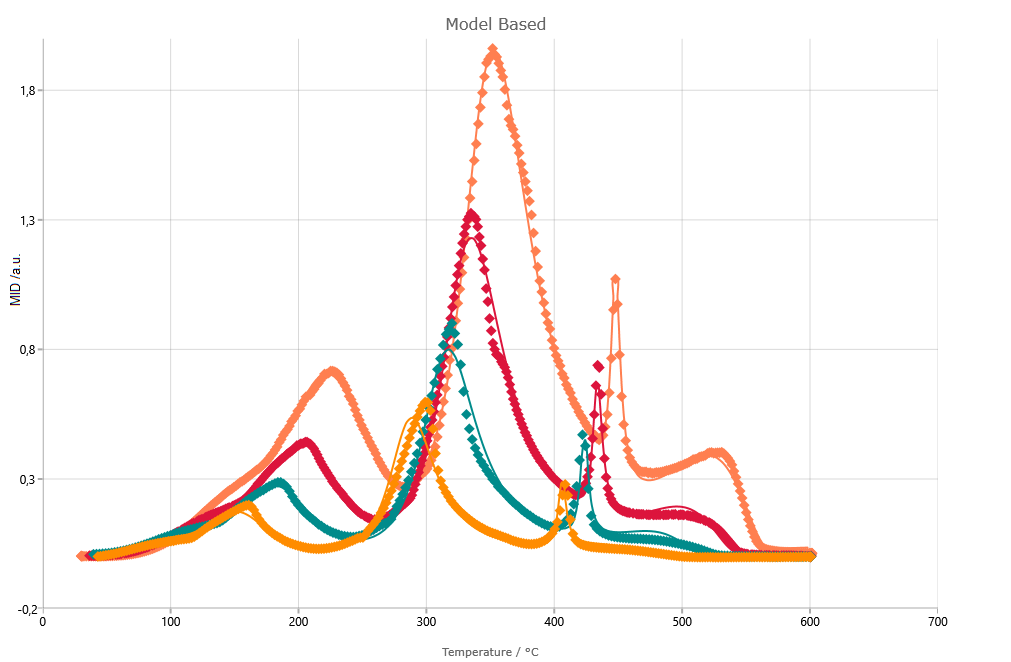
Model-Based Methodsapply powerful cutting-edge mathematical calculations to create the best kinetic model; the different kinetic models can then also be compared statistically.
Predictions— Kinetics Neo is used for simulations and predictions once the experimental data has been described by either model-free or model-based kinetics. Predictions can be calculated for various temperature programs: isothermal, dynamic, multiple step, step-iso, modulated, or adiabatic.
Optimization is based on predictions; the temperature program can be optimized to achieve maximum product quality in the minimum amount of time.