
An Introduction to n-th Order and Autocatalysis Reactions
5. How to Distinguish between n-th Order and Auto-Catalysis Reactions from Thermal Analysis Curves
Chapters
- Introduction
- Homogeneous Reaction System
- n-th Order Reaction
- Auto-Catalysis Reaction
- How to Distinguish between n-th order and Auto-Catalysis Reactions from Thermal Analysis Curves
- Combined Auto-Catalysis Reaction
- Example: Thermocuring of Epoxy Resin - a Comparison of Different Reaction Types
- Conclusion and References
5. How to Distinguish between n-th Order and Auto-Catalysis Reactions from Thermal Analysis Curves
The distinction between n-th order and auto-catalysis reactions can be seen clearly with isothermal measurements. With fixed temperature, k(T) will be constant, so the kinetics equation can be simplified to:

i.e., the reaction rate dα/dt will be directly proportional to fα. From the previous discussion we know, that:
- for an n-th order reaction f(α) decreases with α monotonously
- for an auto-catalysis reaction, the maxima of f(α) will appear in the middle stage of the reaction.
For isothermal measurement we get the change in dα/dt (for DSC, DTG) over time t; here we must first integrate the equation to obtain α(t), then derive to obtain dα/dt over t.
From a chemical perspective, under isothermal conditions, for an n-th order reaction the reaction rate is proportional to the concentration of reactant. In the beginning, the concentration of reactant is at its highest and the reaction rate is also at its highest. Then, with the consumption of reactant over time, the reaction rate will gradually slow down.
As for auto-catalysis reactions, at the beginning the amount of B is quite low and the catalysis effect is not so evident. So, at that time the reaction rate is quite slow. With the slow reaction rate, the accumulation of product B is also slow, which causes a long “induction period” with a slow rate at the beginning of the reaction.
When the amount of B accumulates to a certain level, the boost effect for the reaction will become evident. As the reaction speeds up, a lot of product B are produced, which further accelerates the reaction. Therefore, in the middle stage, the reaction speeds up very fast. In the final stage, with the dramatic consumption of reactant A, the reaction rate will slow down again, until the reaction finishes.
A typical DSC comparison of the two Reaction typesReaction type is the elementary mechanism of one individual reaction step in multi-step chemical reaction. Reaction type f(Cr, Cp) describes dependence of the reaction rate for individual reaction step on the concentrations of reactant Cr and product Cp for this step.reaction types under isothermal conditions is shown in the Figure 5:
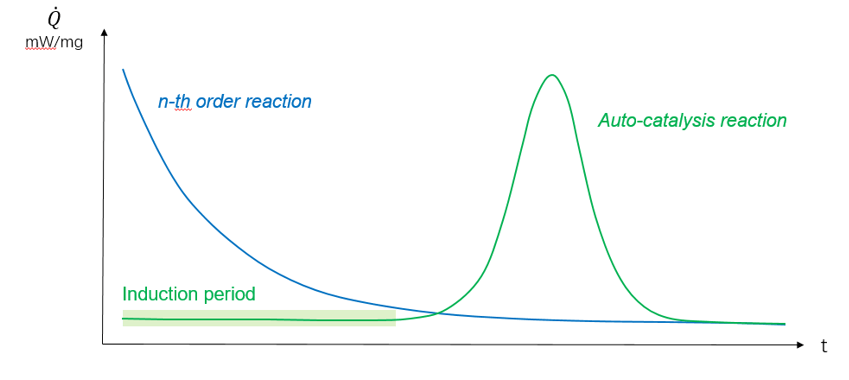
This comparison result can be confirmed mathematically by deducing from equation Eq.8 to dα/dt over t and drawing the plot.
For a dynamic heating test, the complete kinetics equation will be:
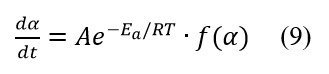
During heating, besides f(α), the influence from the continuous temperature change also exists, and the reaction will also speed up. So even for an n-th order reaction, the maxima rate no longer appears at the starting point.