
Vyazovkin Analysis for Dynamic Data
Vyazovkin Analysis is the model-free (isoconversional) method of kinetic analysis calculating dependence of activation energy E(α) on degree of conversion α for dynamic experiments with different constant heating rates β.
Vyazovkin method is different from Vyazovkin Advanced method .
It is always necessary to check if this model-free method is valid to be used and is applicable because of restrictions of model-free methods.
Vyazovkin analysis belongs to the group of integral model-free methods where firstly, the integral of main kinetic equation (1) over temperature must be found from begin of reaction to the current conversion α (Eq. 1):
Integral over temperature for constant heating with heating rate β (Eq. 2):
For different heating rates βi and βj at the same degree of conversion α, the following can be written (Eq. 3):
And finally, the following function should be minimized to find activation energy E(α) [1,2] (Eq.4):
Where Tαi is the temperature at which the conversion α is reached for the heating rate βi.
Advantages and disadvantages of this method and a comparison table with other methods.
Example
Decomposition of La(OH)3: experimental data, Activation energy E(α), pre-exponent A(α) and comparison between experiments and simulation for Vyazovkin dependences E(α) and A(α):
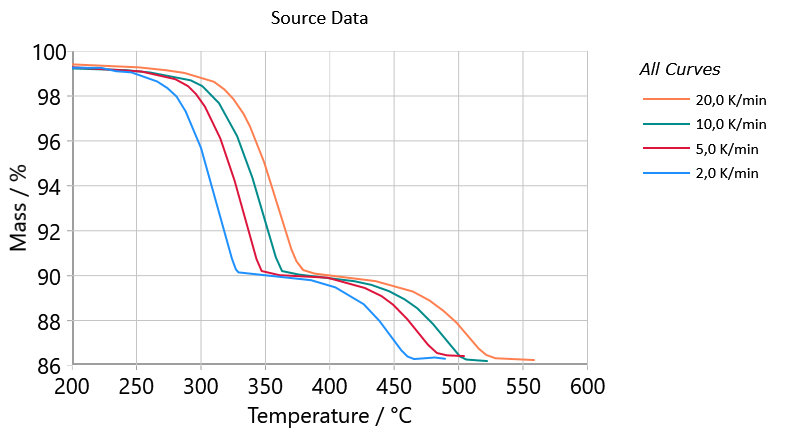
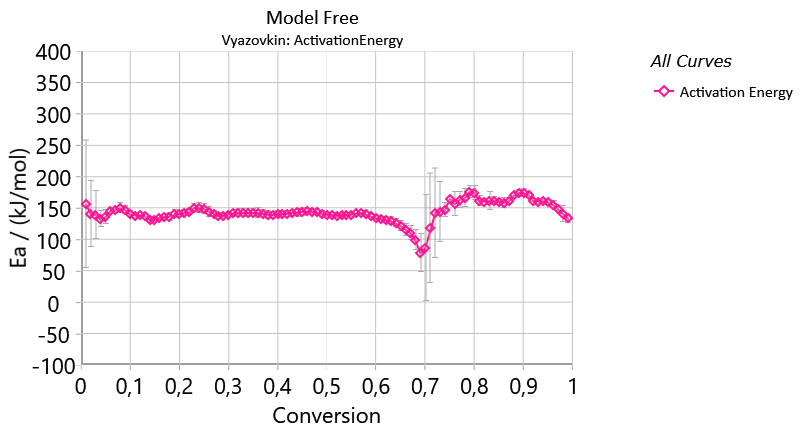
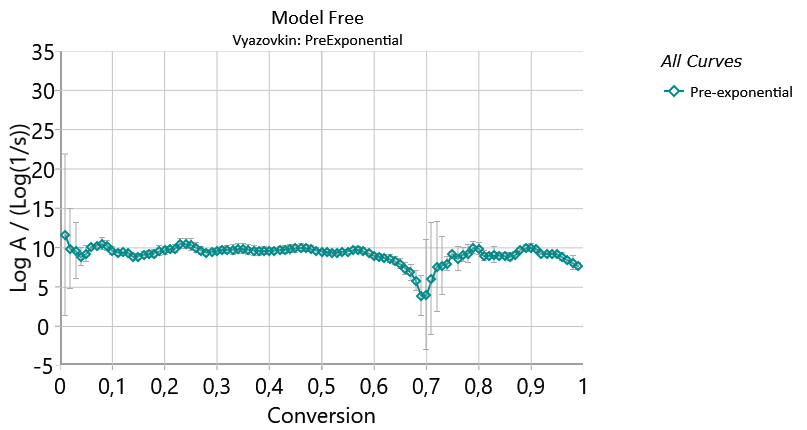
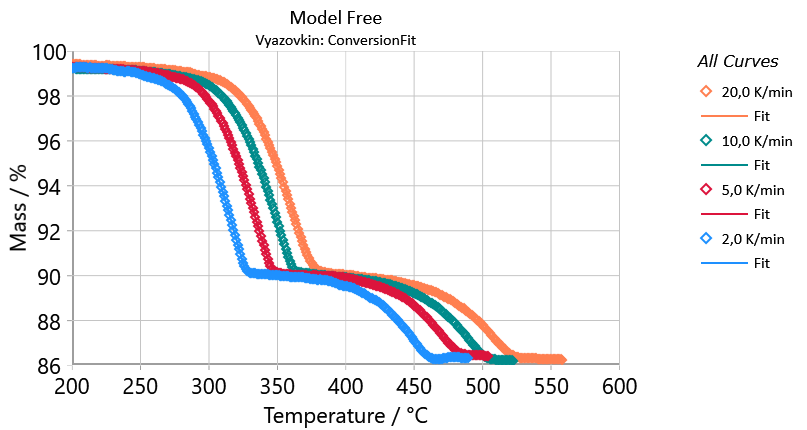
It is always necessary to simulate the curves by Vyazovkin method and compare them with experiment. This comparison helps to check if Vyazovkin method is suitable for analysis of the current reaction.
References
[1]S. Vyazovkin, D.Dollimore, J.Chem.Inf.Comp.Sci 36(1996) 42-45
https://pubs.acs.org/doi/10.1021/ci950062m
[2] S.Vyazovkin et al. ICTAC Kinetics Committee Recommendations for Performing Kinetic Computatins on Thermal Analysis Data, Thermochimica Acta 520(2011) 1-19 https://doi.org/10.1016/j.tca.2011.03.034