
External Parameters: Samples
Kinetics Neo Version 3.0
Examples of the External Parameter are:
- Intensity of UV light for curing of photopolymers.
- Partial pressure of reactive gaseous component in the surrounding atmosphere, like reduction / oxidation reactions.
- Partial pressure of reactive gaseous component for backward reaction in reversing reactions, like decomposition of Calcium carbonate under presence of carbon dioxide.
- Pressure of inert atmosphere for reversing reactions with gas production.
- Initial concentration of reactive component
Exermal Parameter in Photopolymers: Kinetic UV Intensity
Photoinduced curing reaction depends not on temperature only, but on the intensity of UV light.
Now in Kinetics Neo it is possible to create the common kinetic model depending on two parameters: temperature and intensity of UV light.
Next figure presents the kinetic model for isothermal DEA measurements at 30°C for light exposure an different intensities from 75W/cm2 to 150W/cm2.
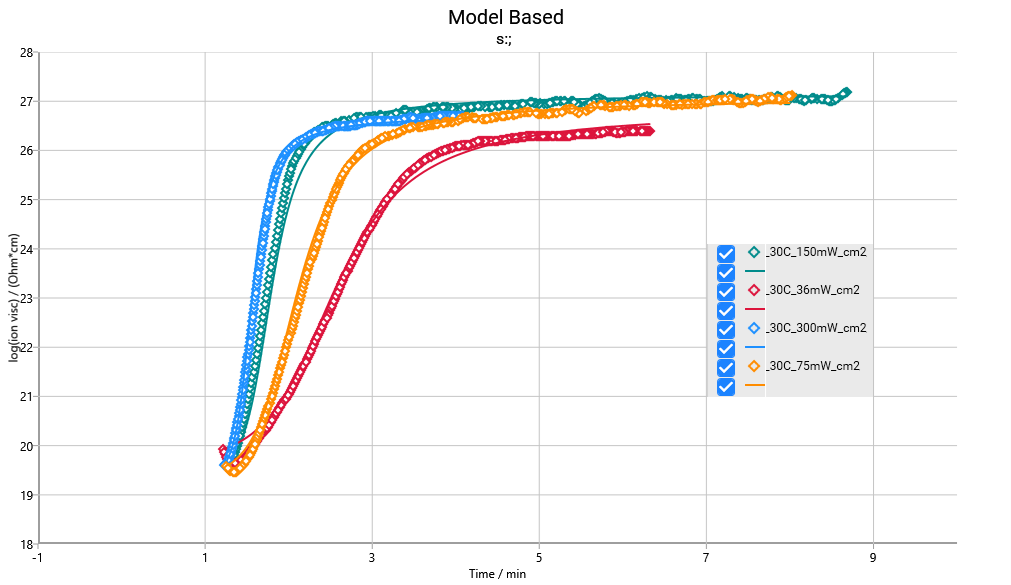
This common kinetic model is created for the measurement at different UV intensities at temperatures 30, 90, 150°C. See details of measurement conditions (link https://doi.org/10.1002/pen.26353 ).
Partial pressure of reactive gaseous reactant
Many solid materials react with the gaseous component, for example during oxidation. The reaction rate in this case depends not only on the temperature but also on the concentration of the reactive gaseous component, which I proportional to the partial pressure of this component in the gaseous surrounding.
Now in Kinetics Neo it is possible to create the common kinetic model, depending on both external parameters: temperature and partial pressure of the gaseous reactant.
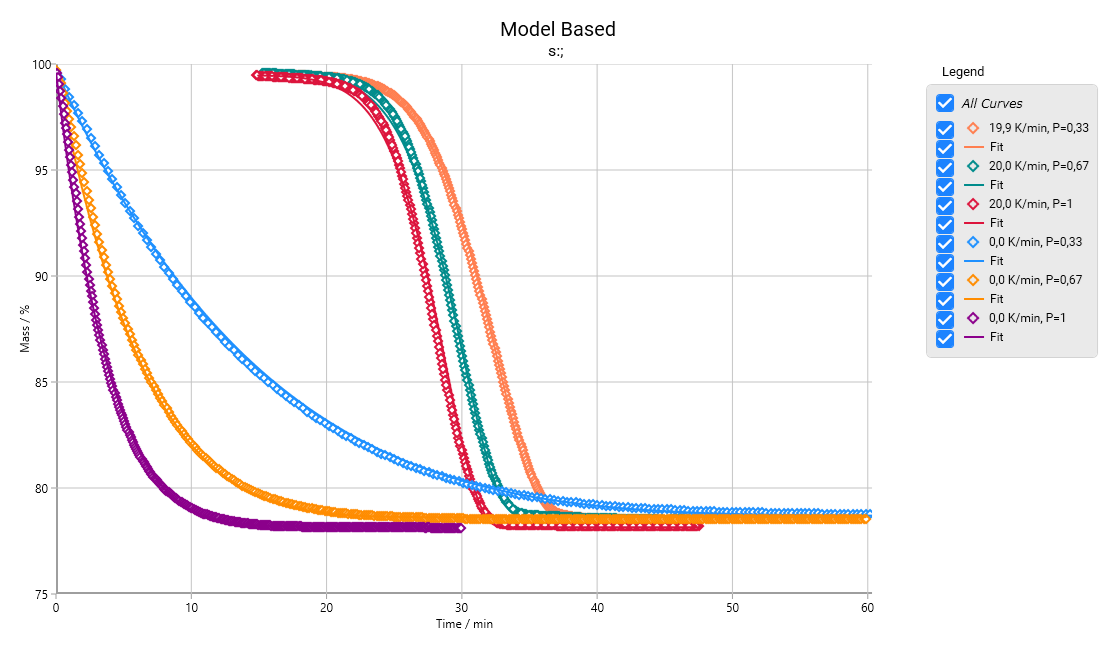
This figure above presents the common kinetic model for reduction of metal oxide to pure metal in the atmosphere containing hydrogen. The data for kinetic modelling consist of three dynamic measurements at 20K/min and three isothermal measurements at 600°C. Both dynamic and isothermal measurements are carried out under different partial pressures of Hydrogen: 33%, 67% and 100%.
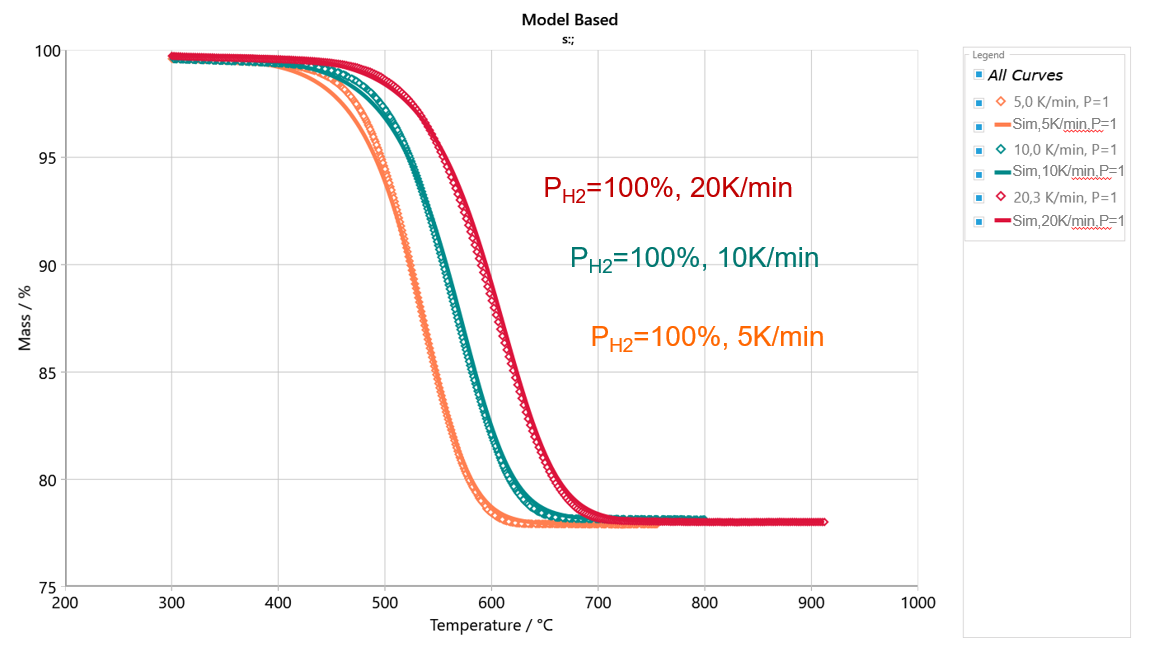
Verification is done for pure hydrogen at different heating rates. Simulation in Kinetics Neo are in good agreement with verification experiments.
Reversible reactions with gaseous reactant in backward reaction
In reversible reactions A ⇌ B, two chemical reactions occur simultaneously.
The first one is the forward reaction A → B, the second one is the backward reaction is B → A.
In the closed systems the concentrations of A and B are in equilibrium, where the rates of forward reaction and backward reaction are equal.
However, in thermal analysis like DSC or TG, the system is open, and no equilibrium happens. The total reaction rate of measured data is the difference between the forward reaction and backward reaction:
Rection rate total=Reaction rate forward – Reaction rate backward
Example: measurements with different partial pressure of reactive gaseous component for backward reaction in reversing reactions, like decomposition of Calcium carbonate under presence of carbon dioxide.
The data for the kinetic analysis are measured in the mixture of N2 and CO2 at different partial pressures of CO2: 30%, 10% and 0% (last means pure Nitrogen atmosphere).
For each partial pressure the measurements at three different heating rates are done: 5,10 and 20K/min.
The common kinetic model the same set of parameters is created for all 9 measurements:In reversible reactions A⇌B, two chemical reactions occur simultaneously.
The first one is the forward reaction A → B, the second one is the backward reaction is B → A.
In the closed systems the concentrations of A and B are in equilibrium, where the rates of forward reaction and backward reaction are equal.
However, in thermal analysis like DSC or TG, the system is open, and no equilibrium happens. The total reaction rate of measured data is the difference between the forward reaction and backward reaction:
Rection rate total=Reaction rate forward – Reaction rate backward
Example: measurements with different partial pressure of reactive gaseous component for backward reaction in reversing reactions, like decomposition of Calcium carbonate under presence of carbon dioxide.
The data for the kinetic analysis are measured in the mixture of N2 and CO2 at different partial pressures of CO2: 30%, 10% and 0% (last means pure Nitrogen atmosphere).
For each partial pressure the measurements at three different heating rates are done: 5,10 and 20K/min.
The common kinetic model the same set of parameters is created for all 9 measurements: