
What Is New in Kinetics Neo Version 3.0
Build 3.0.24313.1
Contents
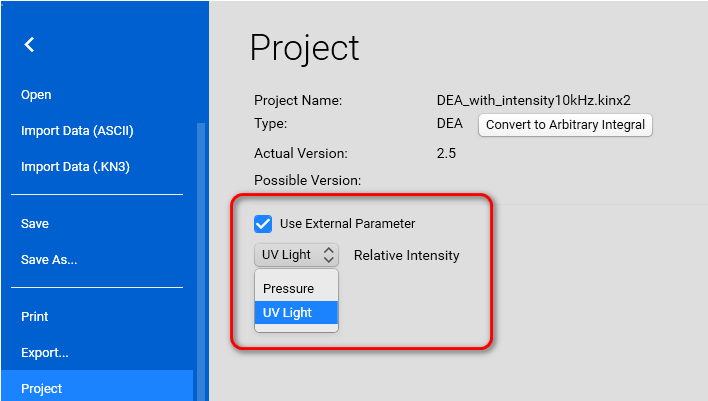
Added: Intensity of UV light as Additional Parameter in kinetic analysis. New possibility to create common kinetic model depending on temperature and light intensity.
Added: Partial pressure of gaseous reactant as Additional Parameter in kinetic analysis. New possibility to create common kinetic model depending on temperature and partial pressure.
Added: Total pressure as Additional Parameter in kinetic analysis for reactions in inert gas. New possibility to create kinetic common model depending on temperature and pressure.
Added: Projects for arbitrary data types, which are non-standard in Kinetics Neo, like mass-spectrometry, concentrations, conversion, storage modulus, absorbance.
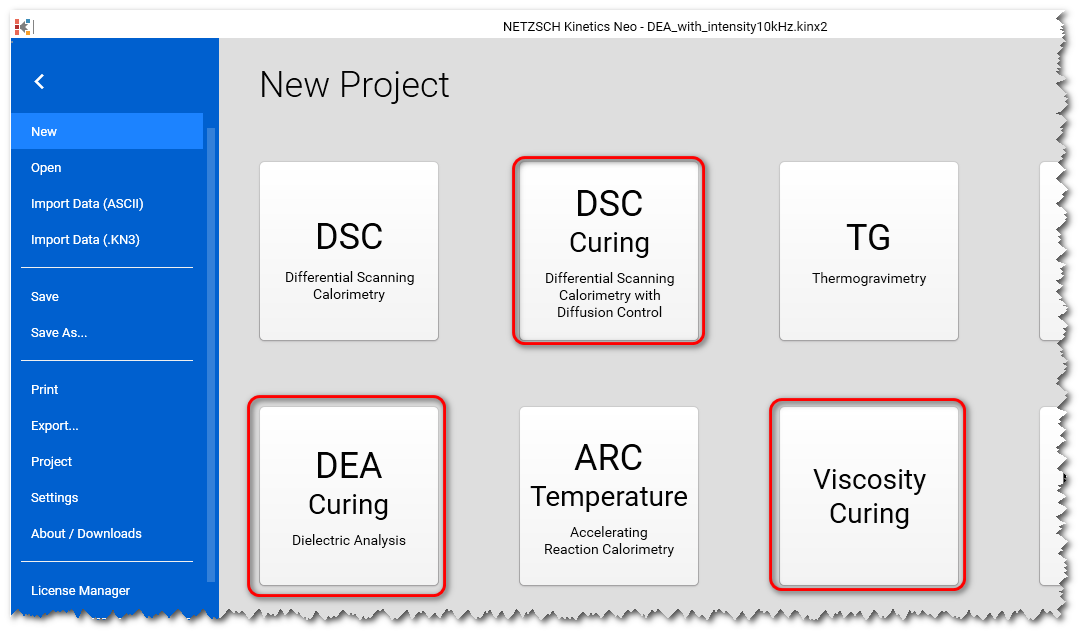
Added: Kinetics for curing reactions with diffusion control, measured by DEA or Rheology.
Added: Reaction type reversible reactions.
Added: New reaction type DFn for diffusion with reaction of n-th order.
Added: User Interface (UI) is reworked for consistent native look in Windows 11.
Added: Dozens of new colorful themes for User Interface (UI) are added. Special dark themes are also introduced.
Other improvements and bug fixes.
Intensity of UV Light as Additional Parameter in Kinetic Analysis
Photoinduced curing reaction depends not on temperature only, but on the intensity of UV light.
Now in Kinetics Neo it is possible to create the common kinetic model depending on two parameters: temperature and intensity of UV light.
Next figure presents the kinetic model for isothermal DEA measurements at 30°C for light exposure an different intensities from 36 mW/cm2 to 300 mW/cm2.
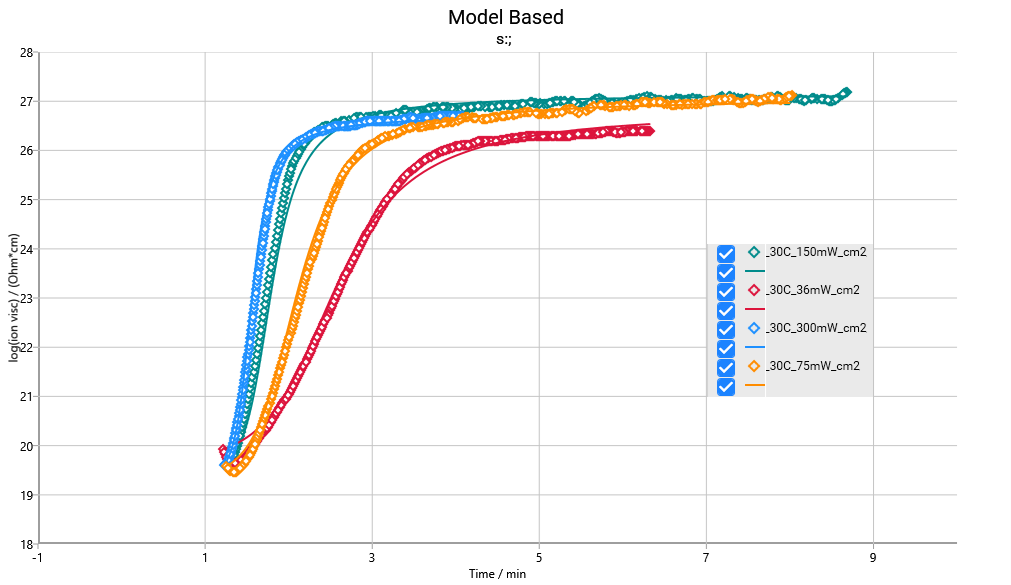
This common kinetic model is created for the measurement at different UV intensities at temperatures 30, 90, 150°C. See details of measurement conditions (https://doi.org/10.1002/pen.26353 ).
The equations for dependency of reaction rate on the UV intensity can be found in the article: https://doi.org/10.1016/j.polymer.2012.03.025
Partial Pressure of Gaseous Reactant as Additional Parameter in Kinetic Analysis
Many solid materials react with the gaseous component, for example during oxidation. The reaction rate in this case depends not only on the temperature but also on the concentration of the reactive gaseous component, which I proportional to the partial pressure of this component in the gaseous surrounding.
Now in Kinetics Neo it is possible to create the common kinetic model, depending on both external parameters: temperature and partial pressure of the gaseous reactant.
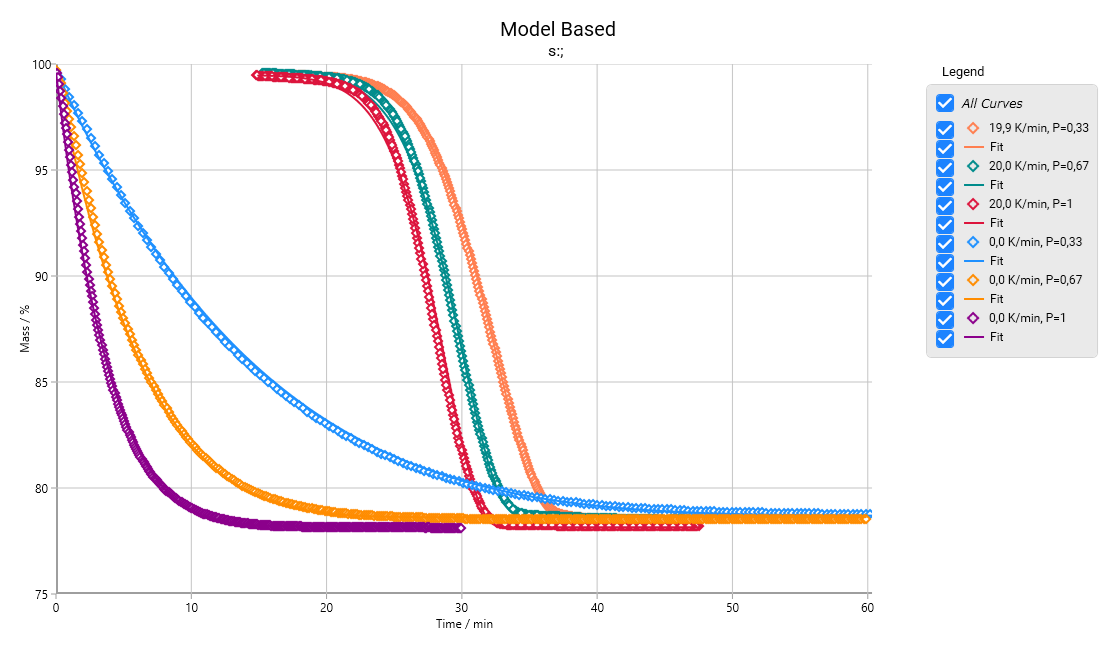
This figure above presents the common kinetic model for reduction of metal oxide to pure metal in the atmosphere containing Hydrogen. The data for kinetic modelling consist of three dynamic measurements at 20K/min and three isothermal measurements at 600°C. Both dynamic and isothermal measurements are carried out under different partial pressures of Hydrogen: 33%, 67% and 100%.
Total Pressure as Additional Parameter in Kinetic Analysis for Reactions in Inert Gas
Decomposition reactions with gaseous products can be pressure-dependent also in inert atmosphere. This happens for the reversible reactions where the presence of gaseous products in the reaction zone slows down the decomposition. Thus, for reversible reactions under the enhanced pressure of inert gas the decomposition happens at higher temperature.
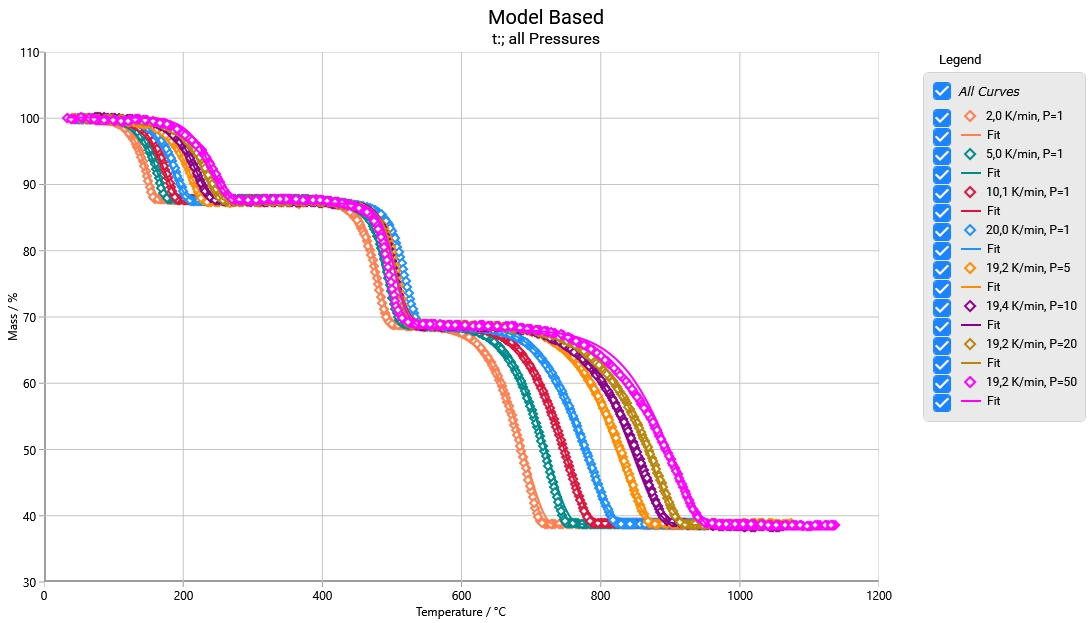
The figure presents the common kinetic model for 8 measurements in N2, where the first 4 of them are measured at different heating rates 2,5,10 and 20 K/min under the normal pressure, and last 4 have the same heating rate 20K/min under different pressures 5,10,20 and 50 bar.
Mode details you can read in our hands-on guide How to Analyze Pressure-Dependent Decomposition in Inert Gas.
Projects for Arbitrary Data Types, which Are Non-Standard in Kinetics Neo
Sometimes the type of measured data differ from the standard data types existing in Kinetics Neo and we got a lot of questions about kinetic analysis of this data https://kinetics.netzsch.com/en/f-a-q/is-it-possible-to-analyze-the-absorbance-or-concentration
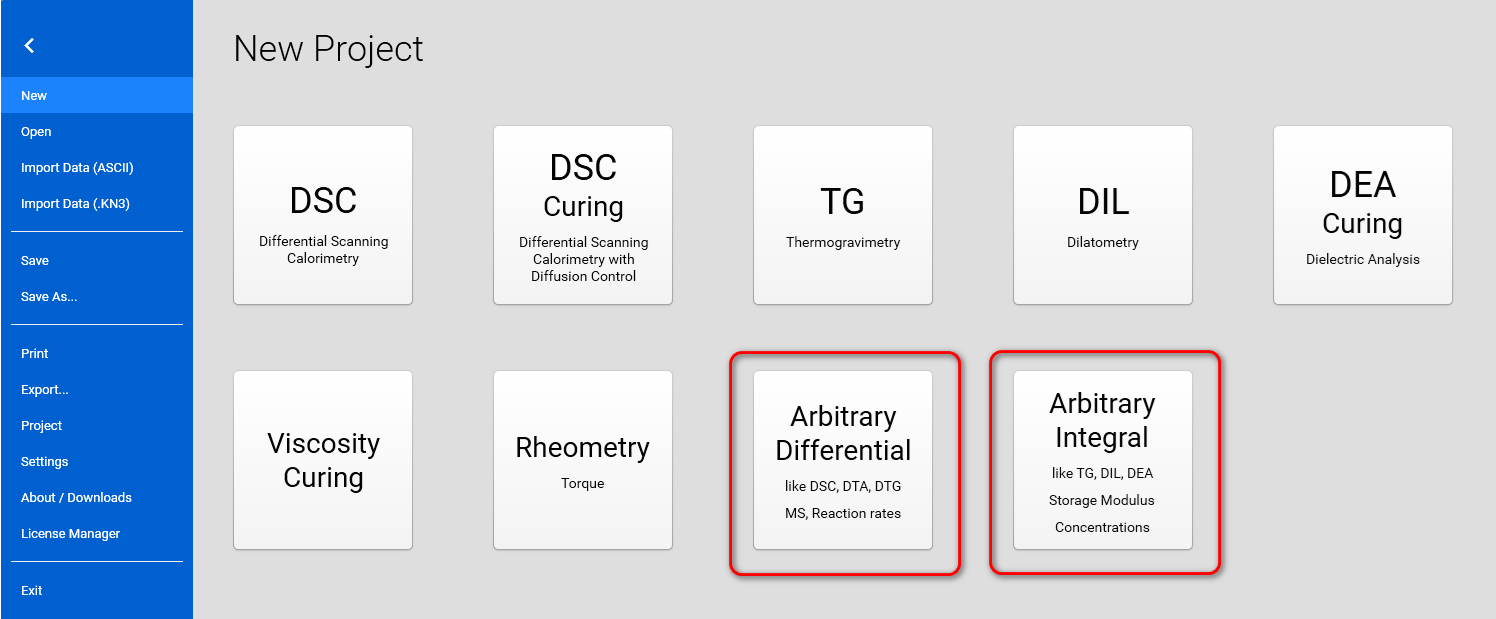
For this reason, we have added two additional project types for arbitrary data.
The first one is the Arbitrary Differential Project for differential data, containing the reaction peak like DSC. It could be for example, the data from mass-spectrometry or differential thermal analysis.
The second project type is the Arbitrary Integral Project for integral data like TG. It could be the measured concentrations, conversion, storage modulus, absorbance or other similar data.
Curing Reactions with Diffusion Control for DEA or Rheology
Reactions of curing and cross-linking near glass transition temperature are diffusion controlled.
Sometimes it is impossible to measure them by DSC method, because after vitrification the curing reaction is very slow, and DSC signal is very weak. Therefore, other measurements methods are used for study this process, like Dielectric Analysis (DEA) or Rheometry.
Now the reaction with diffusion control, measured by DEA or Rheometry, can be also analyzed in Kinetics Neo:
Reversible Reactions
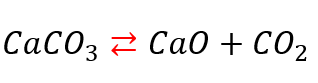
In reversible reactions A⇌B, two chemical reactions occur simultaneously.
In thermal analysis like DSC or TG, the system is open, and no equilibrium happens. The total reaction rate of measured data is the difference between the forward reaction and backward reaction:
Rection rate total=Reaction rate forward – Reaction rate backward
Decomposition of Calcium carbonate under presence of carbon dioxide in reversible reaction and decomposition depends on the partial pressure of CO2.
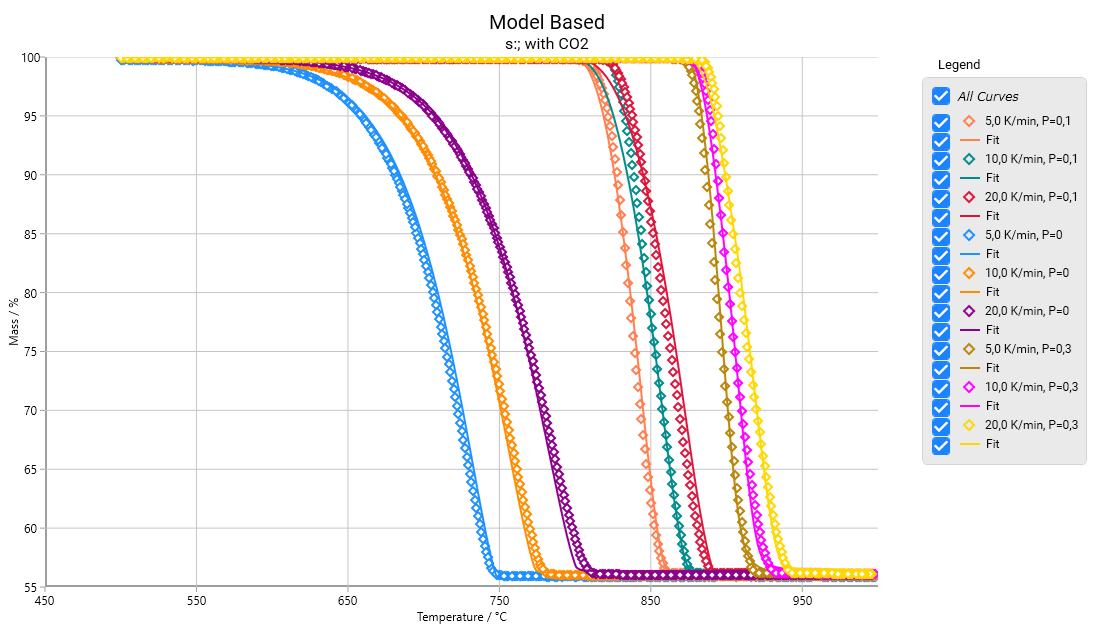
The common kinetic model the same set of parameters is created for 9 measurements, where for each heating rate (5,10,20K/min) three measurements are done under different partial pressure of CO2 (0.3 bar, 0.1 bar and 0 bar)
(see details on https://kinetics.netzsch.com/en/learn/how-to-analyze-reversible-reaction )
New reaction type DFn for diffusion with reaction of n-th order
Reactions in solids often depend on the particles geometry and therefore look like phase boundary reactions, which is partial case of n-th order reaction.
Many theoretical kinetic models do not consider such fact, and therefore can describe well only the initial part of experimental curve. In order to bring such models close to reality, in the literature the advance models are created, where initial part correspond to the pure theoretical model, and final part contains n-th order dependence.
Now we developed the new reaction typeDFn for the first-dimensional diffusion with n-th order. DFn reaction type considers diffusion process in the material during decomposition. It adds the diffusion mechanism to the classical reaction of n-th order (Fn).
Next figures present the rate of two-step decomposition for polymer with the fit according:
- classical reaction Fn (bad fit)
- fit for new reaction type DFn .
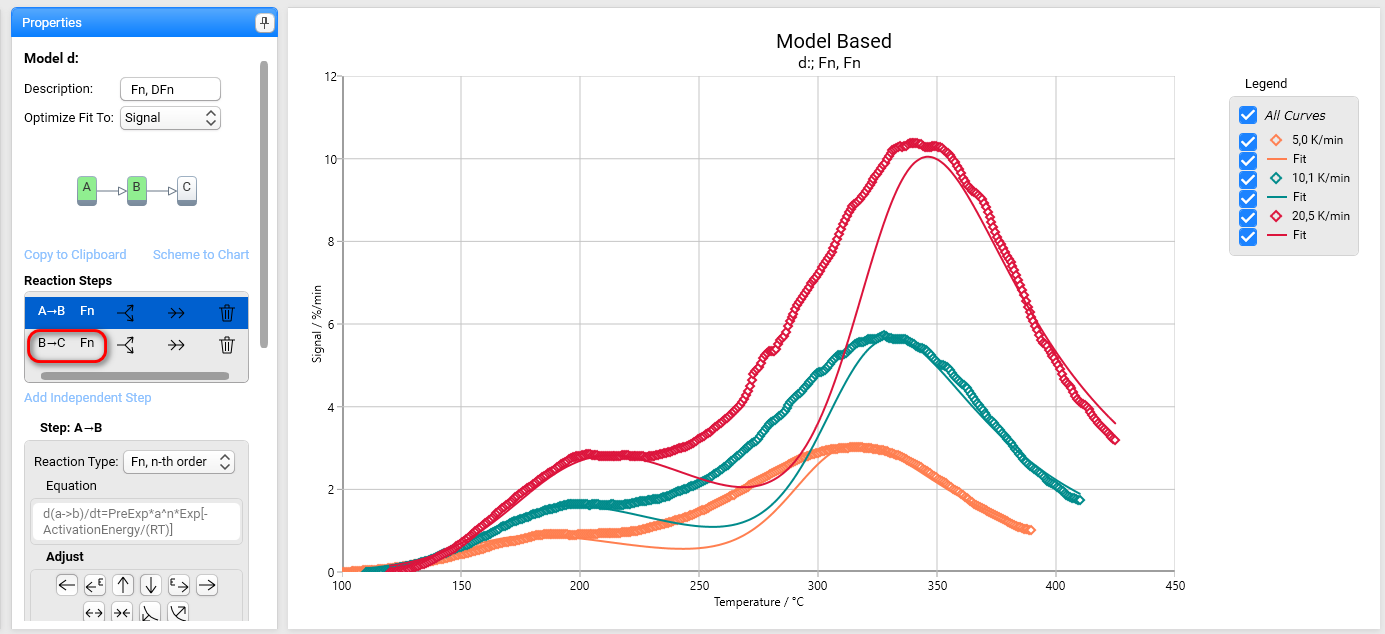
Figure above: double-step model, where main peak is the old Fn reaction. The fit is bad, because the diffusion at the main reaction is not considered.
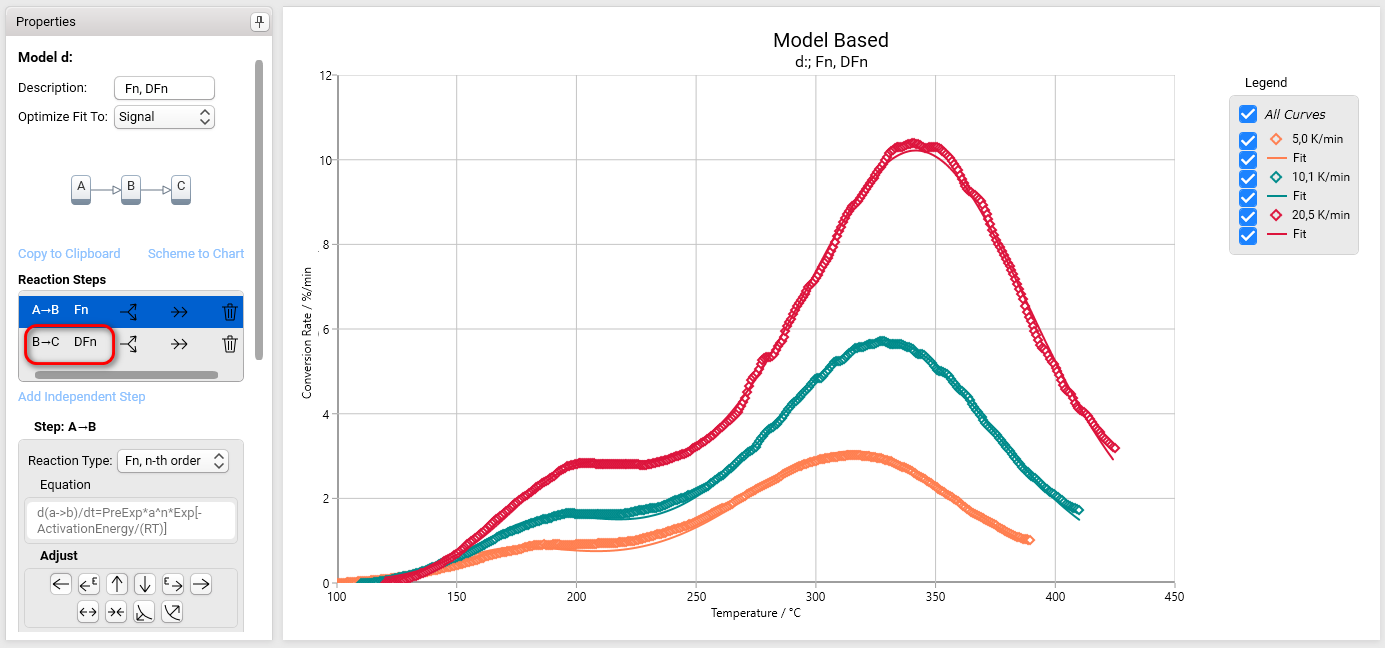
Figure above: double-step model, where main peak is the new DFn reaction (good fit). New reaction type considers diffusion.
Kinetics for Incomplete Measured Data, Where Final Part of Reaction Is not Present
For some reactions the final part of reaction cannot be measured, and the final point of the measurement does not correspond to the conversion value 100%. For example, for curing reaction with diffusion control reaction goes very slow after vitrification and almost cannot be registered by DSC.
However, in some cases, the total effect (total peak area or total mass loss) can be sometimes estimated by other measurements or methods and this value can be used for calculation of conversion value.
Now we are able to calculate the conversion for incomplete data, where final part of reaction is not measured:
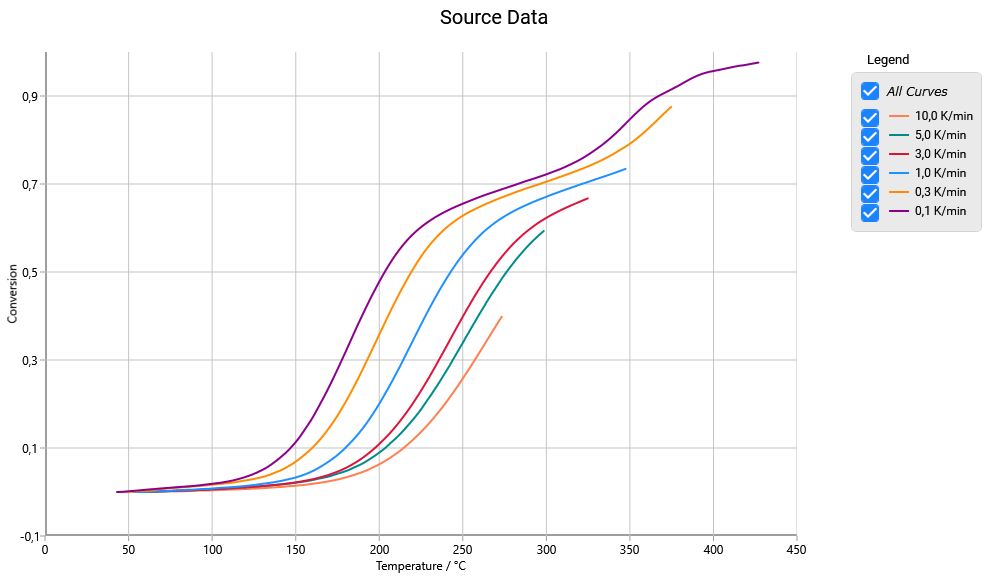
Additionally, our model-free Numerical method works well for these data, where activation energy is calculated smoothly using different number of measured curves at different values of conversion.
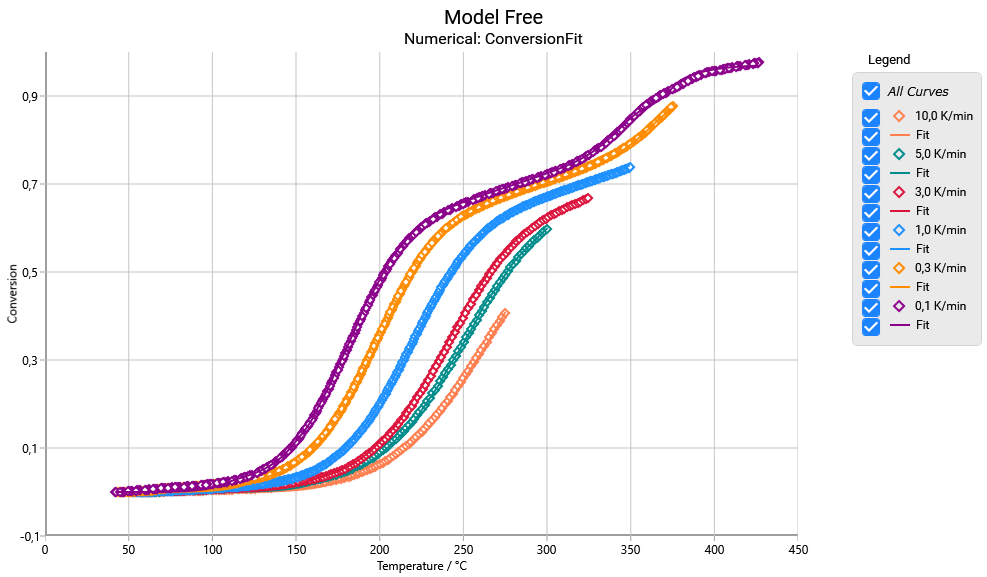
For additional information, see our training example: https://kinetics.netzsch.com/en/learn/how-to-calculate-conversion-for-incomplete-measured-data .