
Deconvolution of DSC Peak
Deconvolution of DSC peak is the mathematical operation, which from the measured DSC signal removes the DSC sensor properties like time constant and gets the power of heat production/consumption of material itself.
For the arbitrary system function g(t) of DSC sensor and evolved heat f(t) in the sample the measured DSC signal looks like:
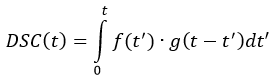
For the simplest case the system function of the instrument is the exponential g(t)=exp(-t/τ) with time constant τ.
Example
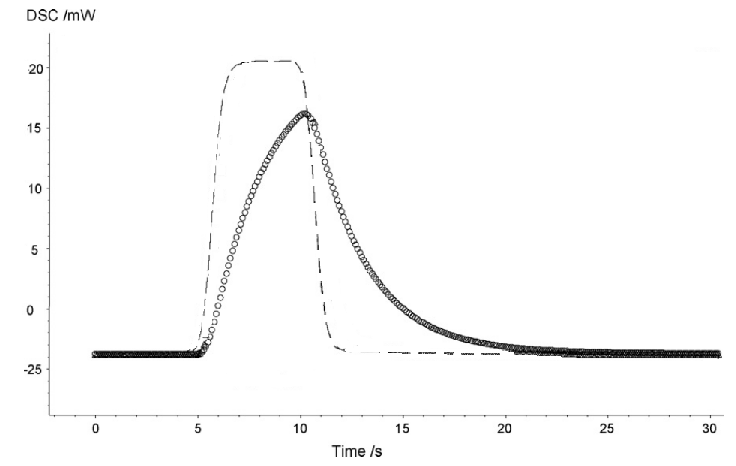
DSC measurement of rectangular light pulse for sensor with one time constant.
The sample position of DSC sensor is exposed by the rectangular light pulse of the constant intensity and fixed duration d. The registered DSC signal contains two parts: the exponential increasing of signal for time from 0 to d, and then the exponential decreasing to zero. DSC deconvolution gets original rectangular pulse shape from the measured experimental DSC signal.
Reference
Elena Moukhina, Erwin Kaisersberger Temperature dependence of the time constants for deconvolution of heat flow curves, Thermochimica Acta, Volume 492, Issues 1–2, 10 August 2009, Pages 101-109